HTTP Status Codes
HTTP 302 Found
Found — target resource resides temporarily under a different URI
A 302 Found response indicates that the requested resource is temporarily available at a different URI specified in the Location header. Because the redirection is temporary, clients should continue using the original URI for future requests, and caching should only occur if explicitly indicated by cache-control headers.
Visual summary
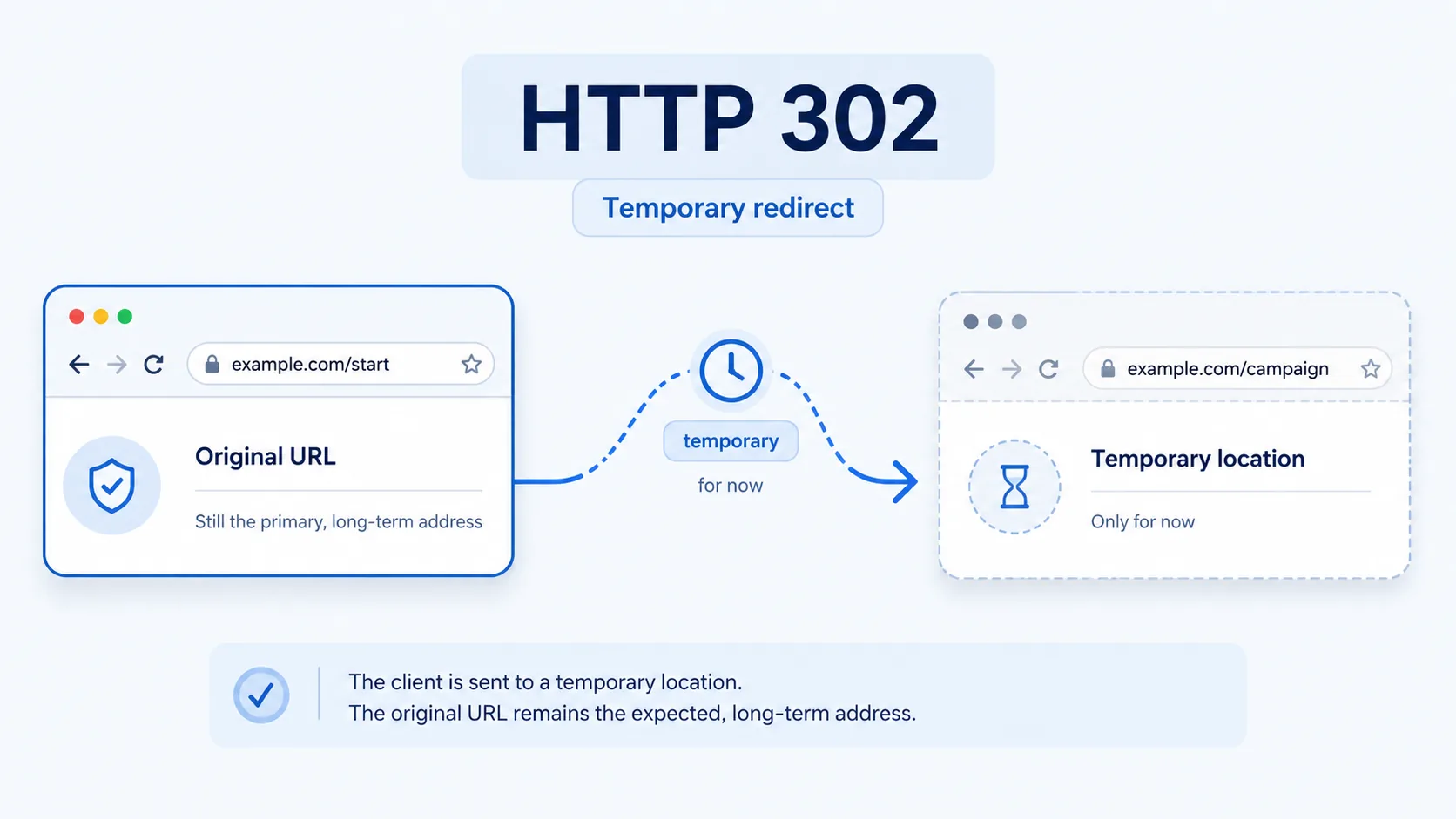
A quick reference view of how HTTP 302 temporarily routes a request elsewhere while the original URL still remains the main address.
What 302 Means
The shortest useful reading of this status code.
Found means target resource resides temporarily under a different URI.
For temporary redirects, the key distinction is that clients are sent elsewhere for now while the original URL still remains the primary address.
Quick read
Temporary URL change
A 302 sends the client to another Location for now while preserving the original URL as the main reference point.
Technical Context
How this status behaves without turning the page into a repair guide.
Temporary target
The 302 Found status was originally defined in HTTP/1.0 as 'Moved Temporarily'. In legacy web browsers, a popular historical behavior emerged where clients rewritten POST requests to GET upon receiving a 302 status, changing the HTTP method.
Original URL retained
To eliminate ambiguity, modern HTTP specifications (RFC 9110) introduced 303 See Other (explicit method change to GET) and 307 Temporary Redirect (guaranteed method preservation). When 302 is used today, most HTTP clients continue the legacy behavior of converting unsafe methods to GET.
Compare Redirect Codes
Redirect status codes look similar in search results, so this page highlights the distinctions that make 302 different.
302
Found
target resource resides temporarily under a different URI
301
Moved Permanently
the requested resource has been assigned a new permanent URL
303
See Other
the response is available at a different URL via GET
307
Temporary Redirect
the resource temporarily resides at a different location
Common Causes
Temporary redirection during routine maintenance or server load balancing
A common condition that triggers a 302 response when the web server evaluates the transaction.
Authentication workflows redirecting unauthenticated users to a login portal
A common condition that triggers a 302 response when the web server evaluates the transaction.
Geo-targeted routing sending visitors to localized resource paths
A common condition that triggers a 302 response when the web server evaluates the transaction.
Typical Scenarios
A web server temporarily redirects incoming traffic to a maintenance page during deployment
An application redirects an unauthenticated visitor to a login form while retaining the return URL
A localized web portal redirects international visitors to region-specific endpoints
What To Know
Encountering a 302 status confirms that the server responded with a temporary alternative location. If preserving the original HTTP method (such as POST or PUT) is critical, modern architectures typically employ 307 Temporary Redirect instead.
Frequently Asked Questions
Common interpretation questions about HTTP 302.
A 301 signals a permanent move, while a 302 signals a temporary one. The original URL is still treated as the primary address with 302.
Yes. The client follows the Location header and loads another URL, but the redirect itself does not say the original address has been retired permanently.
It can be cached when the response includes caching instructions, but it is not treated like the strongly persistent redirect signal associated with 301 or 308.