HTTP Status Codes
HTTP 415 Unsupported Media Type
Unsupported Media Type — the request body format is not accepted here
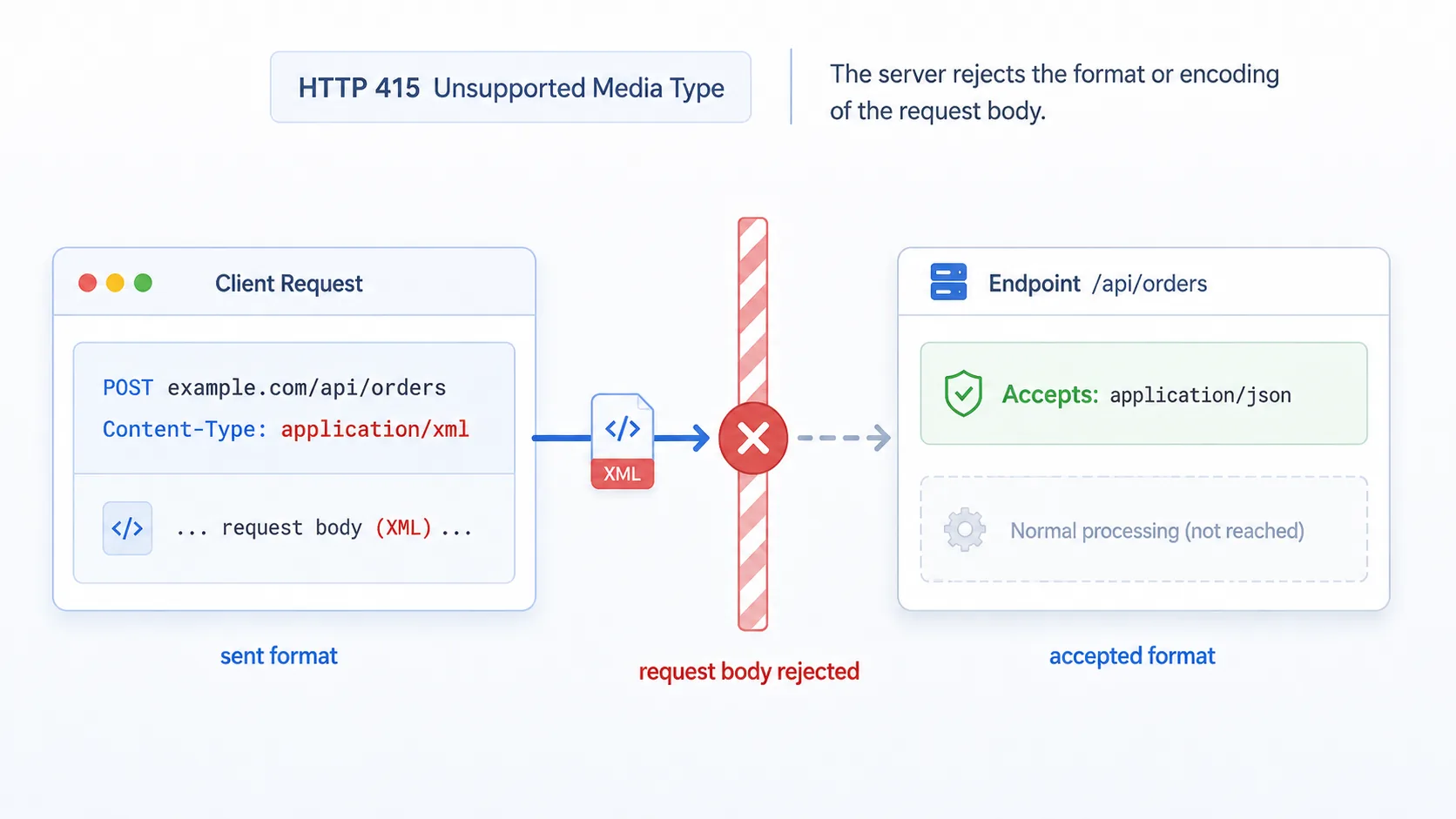
A 415 Unsupported Media Type response means the server rejects the format or encoding of the request body. The request may reach the correct endpoint, but the input contract for that route does not accept the media type, body encoding, or content packaging used by the client.
Visual summary
A quick reference view of how HTTP 415 rejects the format or encoding of the request body rather than the desired response format.
What 415 Means
The shortest useful reading of this status code.
Unsupported Media Type means the request body format is not accepted here.
For content negotiation, the key distinction is that 415 is about the format the client sends, not the format the client wants back.
Quick read
Input format not accepted
A 415 means the server rejects the format or encoding of the request body, not the desired response format.
Technical Context
How this status behaves without turning the page into a repair guide.
Input media type
A 415 is about the input side of the exchange. The server is not saying the URL is wrong or that the response format is unavailable. It is saying the body that the client sent cannot be accepted in this context because the declared media type or encoding does not match the endpoint's accepted request contract.
Negotiation contrast
That makes 415 different from 406, 400, and 422. A 406 is about the response format the client wants back, a 400 is a broader malformed-request signal, and a 422 usually means the body was readable but still semantically unacceptable. A 415 stops earlier at the request-body format boundary.
Related HTTP Codes
Nearby HTTP status codes help clarify how 415 differs inside the same response family.
415
Unsupported Media Type
the request body format is not accepted here
400
Bad Request
the server cannot process the request because it is malformed
406
Not Acceptable
the server cannot produce a response matching the request headers
422
Unprocessable Content
the server understood the request but cannot apply its instructions
Common Causes
Content-Type declares a format the endpoint does not accept
The request body may be present and readable, but the endpoint does not accept that media type here.
Request body encoding conflicts with what the server supports
The payload reaches the server, yet its declared encoding falls outside the accepted input contract.
Client sends JSON, XML, or form data to the wrong endpoint
The request format belongs to a different endpoint or workflow than the one currently targeted.
Upload format is valid but unsupported for that operation
The media type exists and may work elsewhere, but not for this specific action.
Typical Scenarios
An API endpoint expects JSON but receives form data or XML instead
A webhook sends a payload with the wrong Content-Type declaration for that route
An upload request uses a file format that the target operation does not process
What To Know
A 415 usually clusters around one endpoint, integration, or client library rather than the entire site. The visible pattern fits input-format mismatch at the request boundary, not a global outage or a missing resource.
Frequently Asked Questions
Common interpretation questions about HTTP 415.
It usually means the server rejected the format or encoding of the request body. Common examples include the wrong Content-Type, unsupported upload formats, or a route that expects a different kind of payload.
A 415 is about what the client sends to the server. A 406 is about what the client says it is willing to receive back from the server.
Yes. The JSON itself can be valid while the request still fails if the endpoint does not accept JSON there or if the Content-Type declaration does not match what the server expects.