HTTP Status Codes
HTTP 426 Upgrade Required
Upgrade Required — the server demands a different protocol before continuing
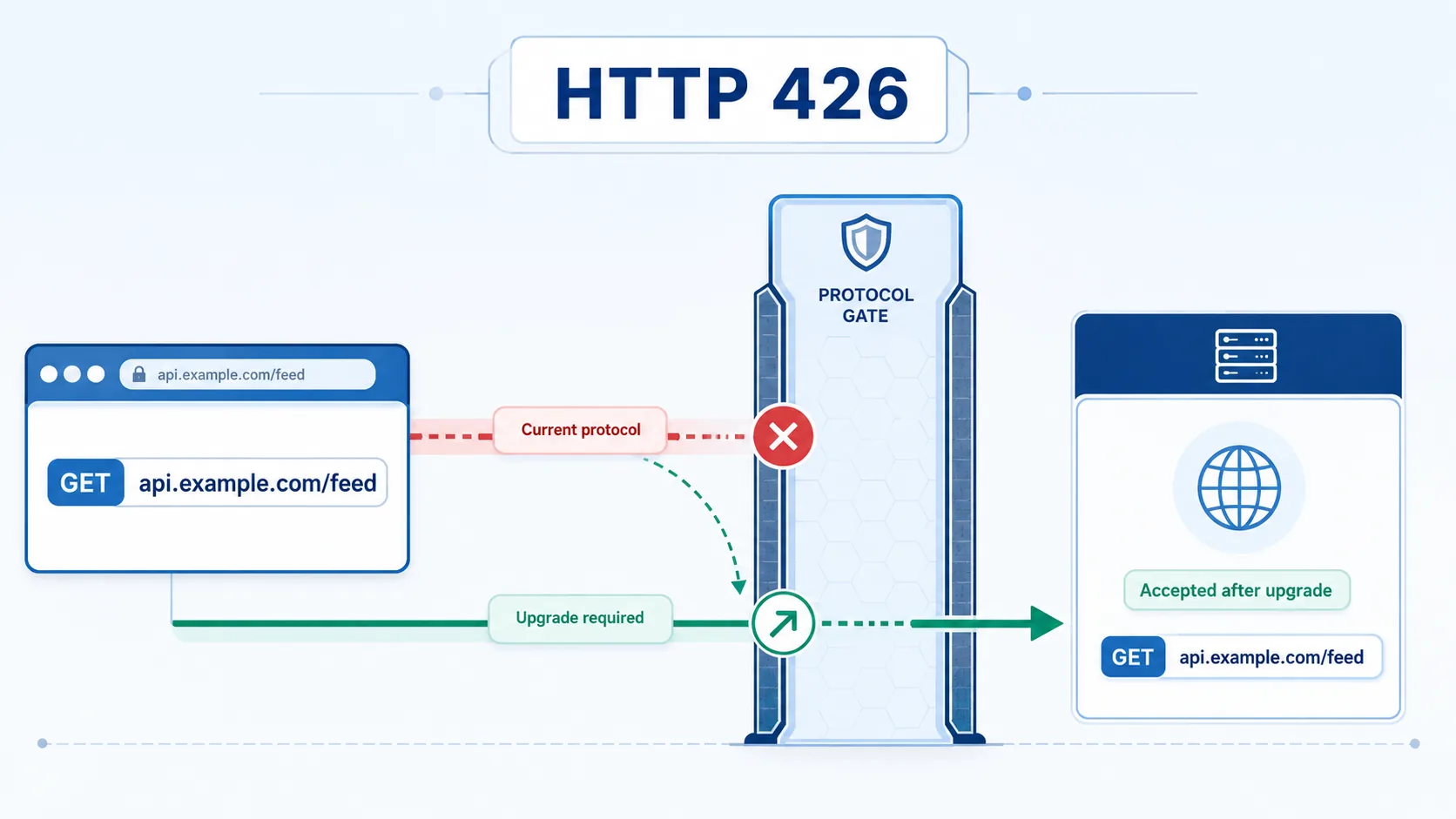
A 426 Upgrade Required response means the server will not continue with the request under the current protocol state. The route may be valid, but the server expects the client to reconnect or renegotiate with a different protocol version, transport capability, or upgrade path first.
Visual summary
A quick reference view of how HTTP 426 refuses to continue under the current protocol state and points toward an upgrade requirement.
What 426 Means
The shortest useful reading of this status code.
Upgrade Required means the server demands a different protocol before continuing.
For upgrade responses, the key distinction is that the server is rejecting the current protocol state rather than the URL or payload itself.
Quick read
Protocol must change first
A 426 means the server will not continue under the current protocol version or transport rules.
Technical Context
How this status behaves without turning the page into a repair guide.
Protocol boundary
A 426 is a protocol-boundary response, not a statement that the URL is missing or that the payload is malformed. The server is effectively saying that the conversation cannot continue under the current protocol contract, even though it may continue under a different one.
Upgrade signal
That makes 426 distinct from 101 and 505. A 101 records a successful protocol switch, while a 505 says the server does not support the HTTP version used for the request. A 426 sits between them as a policy-driven refusal that points toward an upgrade path instead of normal processing.
Related HTTP Codes
Nearby HTTP status codes help clarify how 426 differs inside the same response family.
426
Upgrade Required
the server demands a different protocol before continuing
101
Switching Protocols
the server is switching to the protocol requested by the client
421
Misdirected Request
the request reached a server that cannot answer for that authority
505
HTTP Version Not Supported
HTTP Version Not Supported
Common Causes
Server policy blocks the current HTTP or TLS version
The request arrives successfully, but policy says this version is no longer acceptable for processing.
Endpoint requires a newer transport before processing requests
The server draws the line at protocol capability rather than at application content.
Client reaches a service that only accepts upgraded protocol semantics
The route is valid, but the conversation must continue under a different protocol contract.
Typical Scenarios
A client reaches a service that now requires a newer protocol version than the one it is using
A strict endpoint rejects the current transport and signals that an upgrade path is required
A server policy phase-out leaves older protocol behavior unacceptable for that request path
What To Know
A 426 usually points to protocol policy, transport expectations, or version deprecation rather than to page-level application logic. The visible pattern fits a request that reached the server but could not proceed under the current protocol state.
Frequently Asked Questions
Common interpretation questions about HTTP 426.
It tells the client that the current protocol state is not acceptable for this request and that the server expects a different protocol or upgrade path before continuing.
A 101 means the protocol switch succeeded. A 426 means the server refused to proceed under the current protocol and is pointing toward an upgrade requirement instead.