HTTP Status Codes
HTTP 429 Too Many Requests
Too Many Requests — the client exceeded the allowed request rate
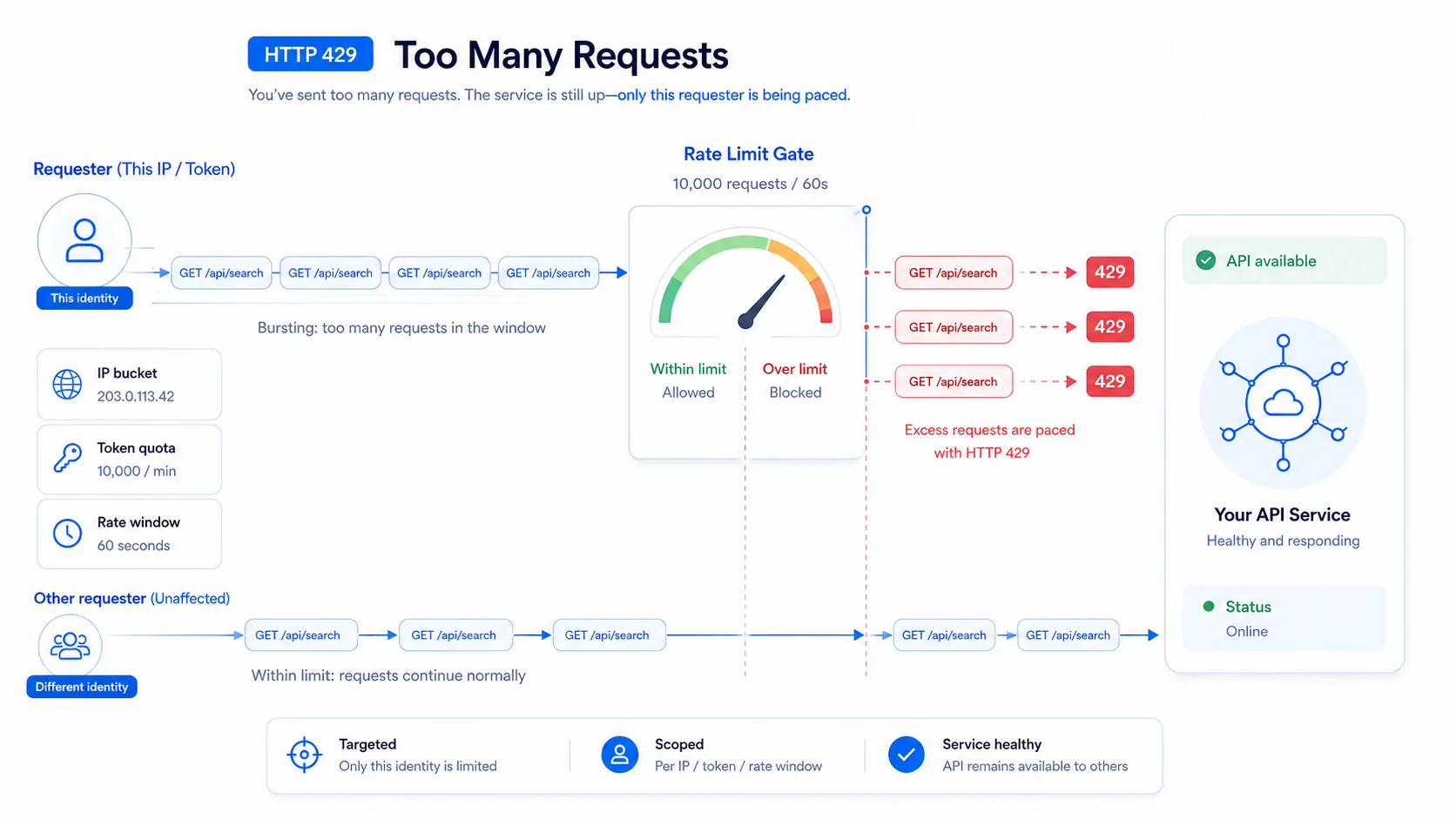
A 429 Too Many Requests response means the service is available, but it is intentionally pacing one requester because the observed request rate crossed an allowed limit. The limiting rule may be tied to an IP address, session, token, account, or another client identity boundary.
Visual summary
A quick reference view of how HTTP 429 paces one requester or quota bucket while the service itself stays available.
What 429 Means
The shortest useful reading of this status code.
Too Many Requests means the client exceeded the allowed request rate.
For rate limiting, the key distinction is that the service is pacing one requester or quota boundary rather than signaling a general outage.
Quick read
Rate limit window active
A 429 means the service is available but pacing requests for one client identity, token, session, or IP.
Technical Context
How this status behaves without turning the page into a repair guide.
Rate limiting
A 429 is best understood as a pacing signal rather than as a generic outage. The server is reachable and still enforcing policy, but it is slowing or blocking one source of traffic because the recent request pattern crossed a quota, fairness rule, or abuse-protection threshold.
Quota scope
That makes 429 different from 503. A 503 is about broader service availability or overload, while a 429 is usually scoped to one requester, one identity bucket, or one short time window. The useful distinction is targeted throttling versus wider unavailability.
Related HTTP Codes
Nearby HTTP status codes help clarify how 429 differs inside the same response family.
429
Too Many Requests
the client exceeded the allowed request rate
401
Unauthorized
valid authentication credentials are missing for the target resource
403
Forbidden
the server understood the request but refuses to authorize it
503
Service Unavailable
the server is temporarily unable to handle this request
Common Causes
Burst traffic exceeds the quota for one client identity
The service is shaping throughput for one requester rather than failing globally.
Repeated login or verification attempts trigger throttling
Protective pacing rules activate when many similar requests arrive in a short window.
Shared IP traffic crosses a per-address request ceiling
Several users or systems can collectively trip a limiter when they share one address.
Crawler or bot behavior trips abuse-protection rules
The server reads the traffic pattern as aggressive enough to slow or block temporarily.
Typical Scenarios
An API client sends requests faster than the current quota window allows
A login flow starts throttling repeated attempts from one user or one address
Multiple users behind the same NAT address collectively cross a shared rate limit
What To Know
A 429 often appears for one client, token, session, or address while the rest of the service continues operating normally. The visible pattern fits request pacing or quota enforcement more strongly than a full application outage.
Frequently Asked Questions
Common interpretation questions about HTTP 429.
No. It usually means the service is up but is currently throttling one requester or quota bucket because the allowed request rate was exceeded.
A 429 is a rate-limit or pacing response scoped to a requester, token, session, or address. A 503 is a broader signal that the service itself is temporarily unavailable or overloaded.
Because many rate limiters group traffic by IP address or another shared identity boundary. Several users or systems can therefore trip the same limiter together even when each one is acting modestly on its own.