HTTP Status Codes
HTTP 451 Unavailable For Legal Reasons
Unavailable For Legal Reasons — the server legally cannot serve the resource
A 451 Unavailable For Legal Reasons implies the server recognizes the requested material but is legally barred from fulfilling the request. The status name intentionally references the dystopian novel Fahrenheit 451, highlighting internet censorship implications.
Visual summary
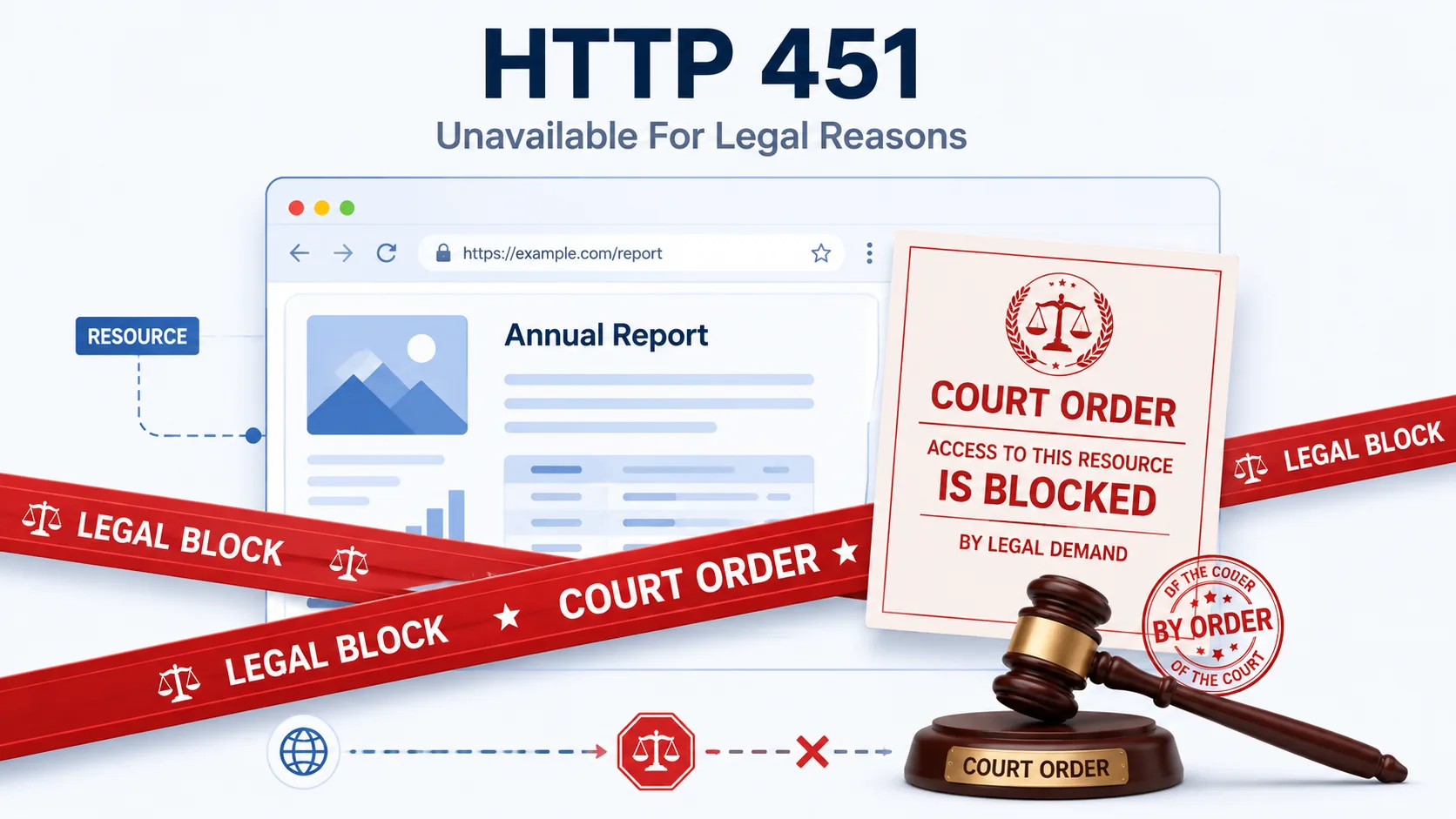
A quick reference view of how HTTP 451 works: An intact resource sealed off by official legal tape or an authoritative injunction.
What 451 Means
The shortest useful reading of this status code.
Unavailable For Legal Reasons means the server legally cannot serve the resource.
This status falls into the 4xx class, indicating a client-side error outcome for the request.
Quick read
Unavailable For Legal Reasons
the server legally cannot serve the resource
Technical Context
How this status behaves without turning the page into a repair guide.
Standard usage
The 451 status is highly unique because it represents external legal pressure rather than an internal engineering decision. It serves as a transparent signal that censorship or compliance barriers, rather than missing files or network errors, are actively blocking access.
Technical nuance
When encountering a 451, the response payload typically contains legal context. It is customary for the server to explicitly name the entity demanding the block and link directly to the legislation or court order governing the restriction.
Implementation detail
The application of 451 is intensely geographic. A website can easily serve a 200 OK to a client browsing from North America while simultaneously serving a 451 to a client attempting access from heavily regulated zones.
Related HTTP Codes
Nearby HTTP status codes help clarify how 451 differs inside the same response family.
451
Unavailable For Legal Reasons
the server legally cannot serve the resource
403
Forbidden
the server understood the request but refuses to authorize it
404
Not Found
the server cannot find the requested resource at this URL
410
Gone
the requested resource was intentionally removed and is no longer available
Common Causes
Government censorship blocking an article within a specific jurisdiction
A common condition that triggers a 451 response when the web server evaluates the transaction.
A court-ordered takedown mandating the removal of intellectual property
A common condition that triggers a 451 response when the web server evaluates the transaction.
Regional GDPR restrictions blocking users from entire media websites
A common condition that triggers a 451 response when the web server evaluates the transaction.
Domain seizure due to trademark infringement or compliance enforcement
A common condition that triggers a 451 response when the web server evaluates the transaction.
Typical Scenarios
A European user attempts to read a US news article and gets a 451 due to privacy laws
A pirated media link returns a 451 after a successful copyright enforcement lawsuit
A telecommunications provider intercepts the connection to enforce national internet blocks
What To Know
A 451 is intentional compliance architecture. System administrators typically deploy these responses at the edge layer, using GeoIP mapping to actively firewall regions and stay compliant with specific legal regimes or government orders.
Frequently Asked Questions
Common interpretation questions about HTTP 451.
You are attempting to access content that the provider is legally forbidden to show you. This is common due to regional privacy laws, copyright disputes, or local government censorship.
It depends entirely on the legal regime. The restriction lasts precisely as long as the court order, copyright claim, or targeted legislation remains actively enforced on the provider.
Frequently, yes. Because legal blocks are usually enforced geographically, using a VPN to appear in an unrestricted country will often allow you to completely bypass a 451 response.