HTTP Status Codes
HTTP 307 Temporary Redirect
Temporary Redirect — the resource temporarily resides at a different location
A 307 Temporary Redirect is the stricter temporary redirect response. It tells the client to follow the Location URL while preserving the original HTTP method and request body.
Visual summary
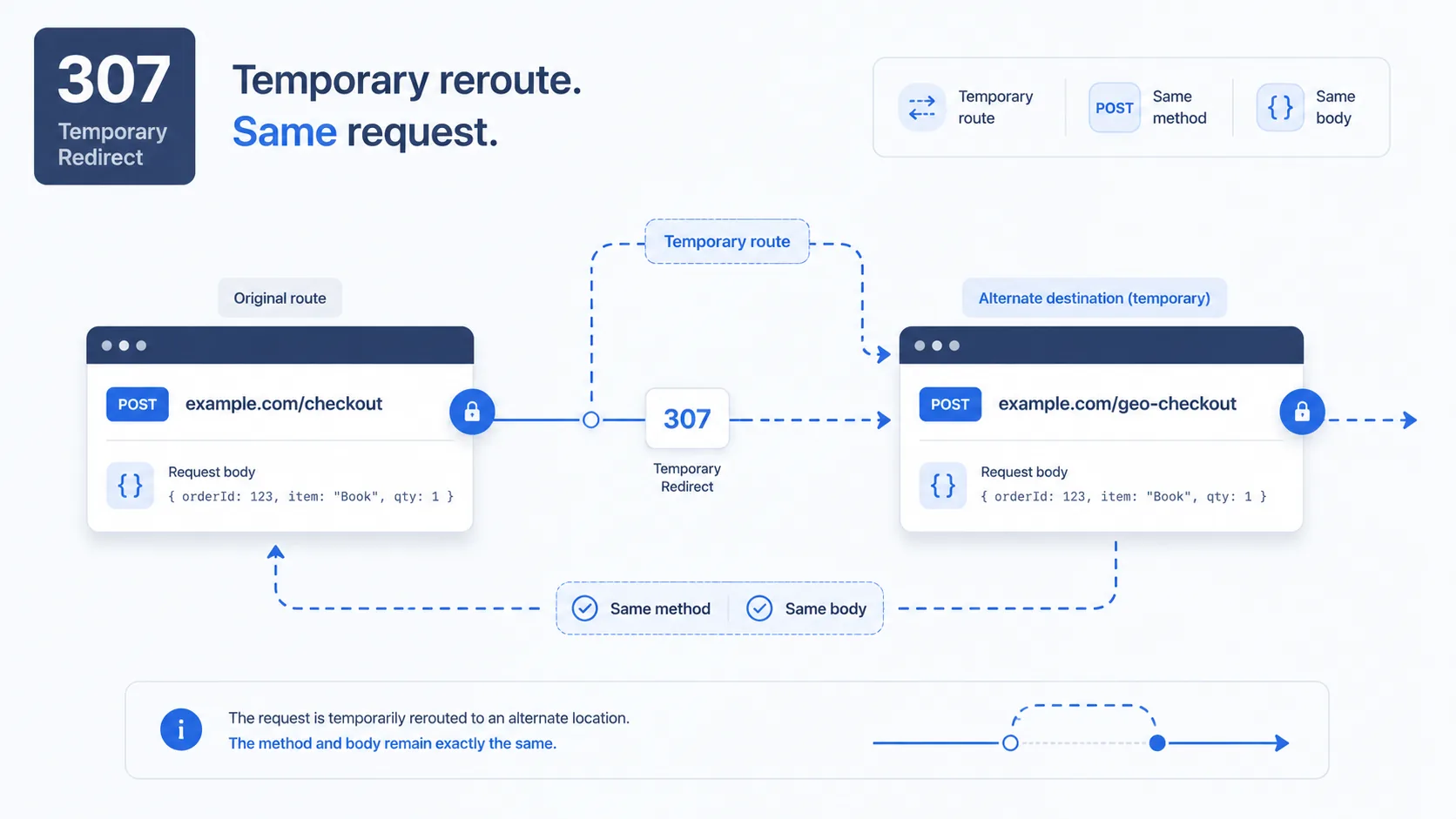
A quick reference view of how HTTP 307 temporarily reroutes a request without changing its method or request body.
What 307 Means
The shortest useful reading of this status code.
Temporary Redirect means the resource temporarily resides at a different location.
For temporary redirects, 307 is the strict form: it points to another location while preserving the original method and request body.
Quick read
Temporary move, same method
A 307 points to another Location while keeping the original HTTP method and request body.
Technical Context
How this status behaves without turning the page into a repair guide.
Temporary target
The creation of the 307 status resolved a historical ambiguity in early web standards. Originally, many browsers incorrectly changed POST requests into GET requests when following a 302 redirect, breaking forms and payment data transmissions in the process.
Method preserved
A 307 explicitly outlaws this behavior. When a client receives a 307 in response to a POST request, it is obligated to reuse the POST method and the exact original body payload when requesting the temporary new address.
Payload integrity
Because of this strict method guarantee, APIs and transactional systems often use 307 instead of 302 when preserving request semantics matters. It reduces ambiguity around whether a non-GET request can be converted into a retrieval request.
Compare Redirect Codes
Redirect status codes look similar in search results, so this page highlights the distinctions that make 307 different.
307
Temporary Redirect
the resource temporarily resides at a different location
302
Found
target resource resides temporarily under a different URI
301
Moved Permanently
the requested resource has been assigned a new permanent URL
308
Permanent Redirect
the resource was permanently moved without method changes
Common Causes
Form submission redirected to a different processing endpoint
The request target changes temporarily while the submitted method and body still matter.
API versioning routing where the method must be preserved
Routing changes, but the original API method must remain intact.
Internal geographic routing prior to serving a resource
Traffic is temporarily pointed toward another location before content is served.
Strict application frameworks enforcing modern standards
Framework routing uses 307 when temporary redirects must preserve request semantics.
Typical Scenarios
An application temporarily redirects a POST form submission to a fallback server
A strict API forces an incoming PUT request to hit an alternative data center
A modern framework defaults to 307 instead of 302 to maintain security expectations
What To Know
A 307 indicates a temporary redirect where the original request method remains significant. When it appears in logs, the key distinction is usually not that the resource is permanently gone, but that traffic is temporarily routed elsewhere without changing the request semantics.
Frequently Asked Questions
Common interpretation questions about HTTP 307.
Both indicate a temporary redirect. However, a 302 historically caused some clients to change POST requests to GET. A 307 strictly requires the client to keep the original method.
A 307 is different when the original HTTP method and request body matter. It removes the historical ambiguity where some clients treated a temporary redirect as an opportunity to change a POST request into a GET request.
Google treats 307 as a temporary redirect signal. The redirect can be followed, but the temporary target is not used as the primary canonical signal in the same way as a permanent redirect.