HTTP Status Codes
HTTP 308 Permanent Redirect
Permanent Redirect — the resource was permanently moved without method changes
A 308 Permanent Redirect is a permanent redirect response with method preservation. Like 301, it points to a lasting destination, but it also tells the client not to change the HTTP method when requesting the new Location.
Visual summary
A quick reference view of how HTTP 308 permanently moves a request to a new URL without changing its method.
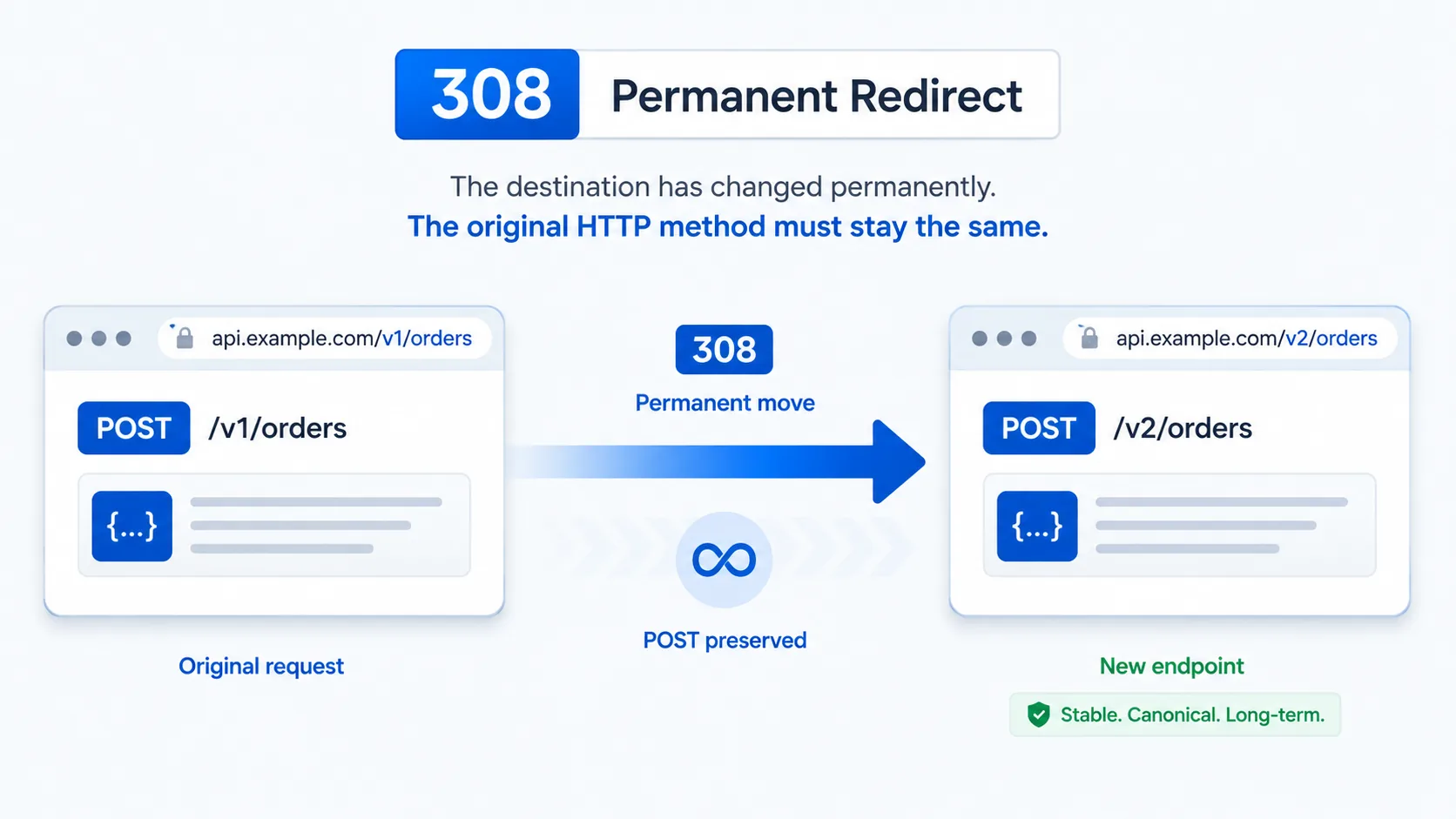
What 308 Means
The shortest useful reading of this status code.
Permanent Redirect means the resource was permanently moved without method changes.
For permanent redirects, 308 is the strict form: it combines a lasting destination change with method preservation.
Quick read
Permanent move, same method
A 308 is permanent like 301, but it explicitly preserves the original HTTP method.
Technical Context
How this status behaves without turning the page into a repair guide.
Permanent target
The 308 code was introduced to mirror the strictness of 307, but for permanent transitions. It directly solves the problem where a 301 Permanent Redirect might accidentally cause an important POST operation to downgrade into a GET request.
Method preserved
For non-idempotent actions such as creating records or submitting data, method preservation can matter because a method change may alter the meaning of the request. A 308 makes that preservation explicit.
Modern redirect
While useful for application and API architecture, 308 is still less common than 301 for simple document navigation. Search engines recognize it as a permanent redirect signal, but the choice between 301 and 308 usually depends on whether request-method preservation matters.
Compare Redirect Codes
Redirect status codes look similar in search results, so this page highlights the distinctions that make 308 different.
308
Permanent Redirect
the resource was permanently moved without method changes
301
Moved Permanently
the requested resource has been assigned a new permanent URL
307
Temporary Redirect
the resource temporarily resides at a different location
302
Found
target resource resides temporarily under a different URI
Common Causes
Complete API sunsetting pointing to a new major version
A retired endpoint points permanently toward a newer API surface.
Permanent migration of transactional form endpoints
A form endpoint moves permanently while method and body preservation remain important.
Strict domain consolidations requiring payload preservation
A domain change is permanent, but request semantics still need to stay intact.
Enforced HTTPS redirection within modern backend frameworks
A framework canonicalizes secure URLs while preserving the original method.
Typical Scenarios
A retired API endpoint redirects an incoming POST request to the v2 infrastructure
A web application permanently moves a sensitive update route to a different subdomain
Data submissions sent to legacy paths are safely bounced to their modern equivalents
What To Know
A 308 redirect indicates a permanent move where request semantics remain important. It is most relevant in contexts where a permanent redirect might involve methods other than GET, such as API or form-submission flows.
Frequently Asked Questions
Common interpretation questions about HTTP 308.
Both mean the resource has moved permanently. However, a 308 explicitly prevents the client from altering the HTTP method, such as changing a POST into a GET.
Yes. Just like a 301, the 308 status signals a permanent move, meaning browsers and proxy servers will cache the redirection heavily by default.
The 308 status is newer, while 301 is older and widely understood for simple document navigation. 308 is more precise when a permanent redirect must preserve the original HTTP method.