HTTP Status Codes
HTTP 103 Early Hints
Early Hints — the server is sending preliminary response headers before the final response
A 103 Early Hints response is an interim status that lets a server send selected response headers before the final status and body are available. It is mainly used to expose preload information early so the client can start fetching critical assets while the origin is still preparing the main response.
Visual summary
A quick reference view of how HTTP 103 sends useful preliminary headers so the client can start fetching critical assets before the final response arrives.
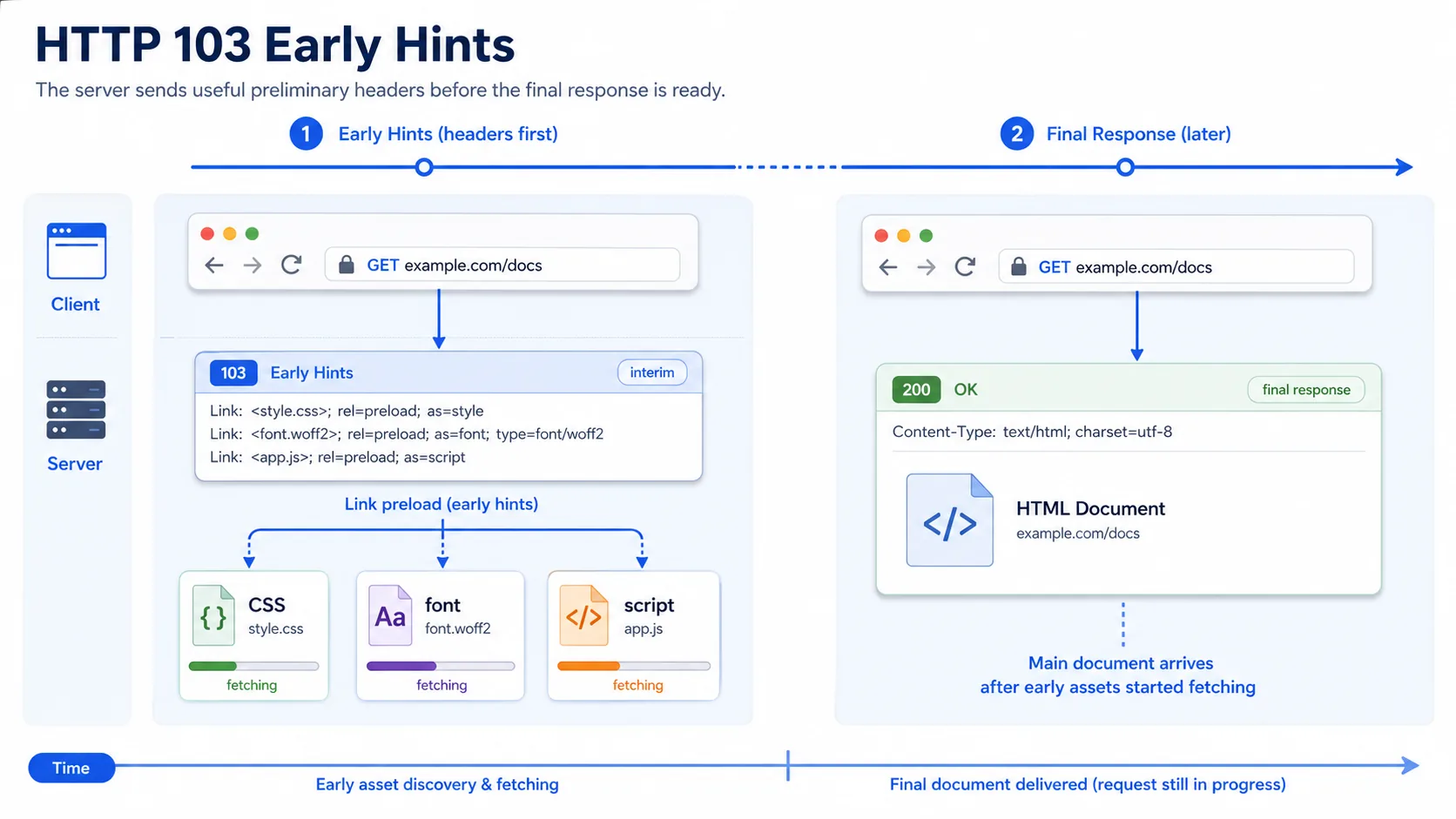
What 103 Means
The shortest useful reading of this status code.
Early Hints means the server is sending preliminary response headers before the final response.
For informational responses, the key distinction is that 103 helps the client start work early without ending the request.
Quick read
Early header signal
A 103 lets the client discover important headers before the final response is ready.
Technical Context
How this status behaves without turning the page into a repair guide.
Interim response
A 103 response is not a final outcome for the request. It belongs to the informational 1xx family, so the client remains in the same request flow and still waits for the real response status such as 200, 301, or 404. Its role is to expose useful headers early rather than to complete the transaction.
Preload signaling
In practice, 103 is most closely tied to performance-oriented Link headers, especially preload relationships. That makes it different from 100 and 101. A 100 is about whether the client should continue sending a request body, while a 101 switches the connection to a different protocol. A 103 stays inside normal HTTP handling and simply gives the client an earlier start on dependent resources.
Related HTTP Codes
Nearby HTTP status codes help clarify how 103 differs inside the same response family.
103
Early Hints
the server is sending preliminary response headers before the final response
100
Continue
server received preliminary request headers and client can transmit body
101
Switching Protocols
the server is switching to the protocol requested by the client
200
OK
the request succeeded and the server returned the expected response
Common Causes
Server emits preload hints before the final response is ready
The origin exposes selected headers early so the client can start dependent work before the final payload exists.
Framework or CDN sends Link headers for critical assets early
The early response advertises assets the browser can fetch while the main document is still being prepared.
Browser navigation waits on stylesheets, fonts, or scripts needed for rendering
The server uses 103 to overlap backend latency with early discovery of render-critical resources.
Typical Scenarios
A page request triggers expensive backend work, but the server sends preload hints for fonts and CSS first
A CDN forwards early Link headers so the browser can begin fetching render-critical files sooner
A framework emits 103 before the eventual 200 response for a document that depends on large front-end bundles
What To Know
A 103 usually appears as an optimization signal rather than as a problem indicator. The key reading is that the server is trying to overlap asset discovery with backend response time, and the request still depends on a later final status before the transaction is complete.
Frequently Asked Questions
Common interpretation questions about HTTP 103.
No. A 103 is only an interim response. The request still ends with a later final status code that determines the real outcome of the transaction.
Its main use is to expose headers like Link early so the browser can begin fetching critical assets before the server finishes generating the full response.