HTTP Status Codes
HTTP 506 Variant Also Negotiates
Variant Also Negotiates — the selected representation has a circular negotiation configuration
A 506 Variant Also Negotiates response means the server selected a representation that is itself configured as another negotiable resource, creating a circular negotiation condition. It is a server-side configuration problem tied to representation selection rather than a generic internal crash.
Visual summary
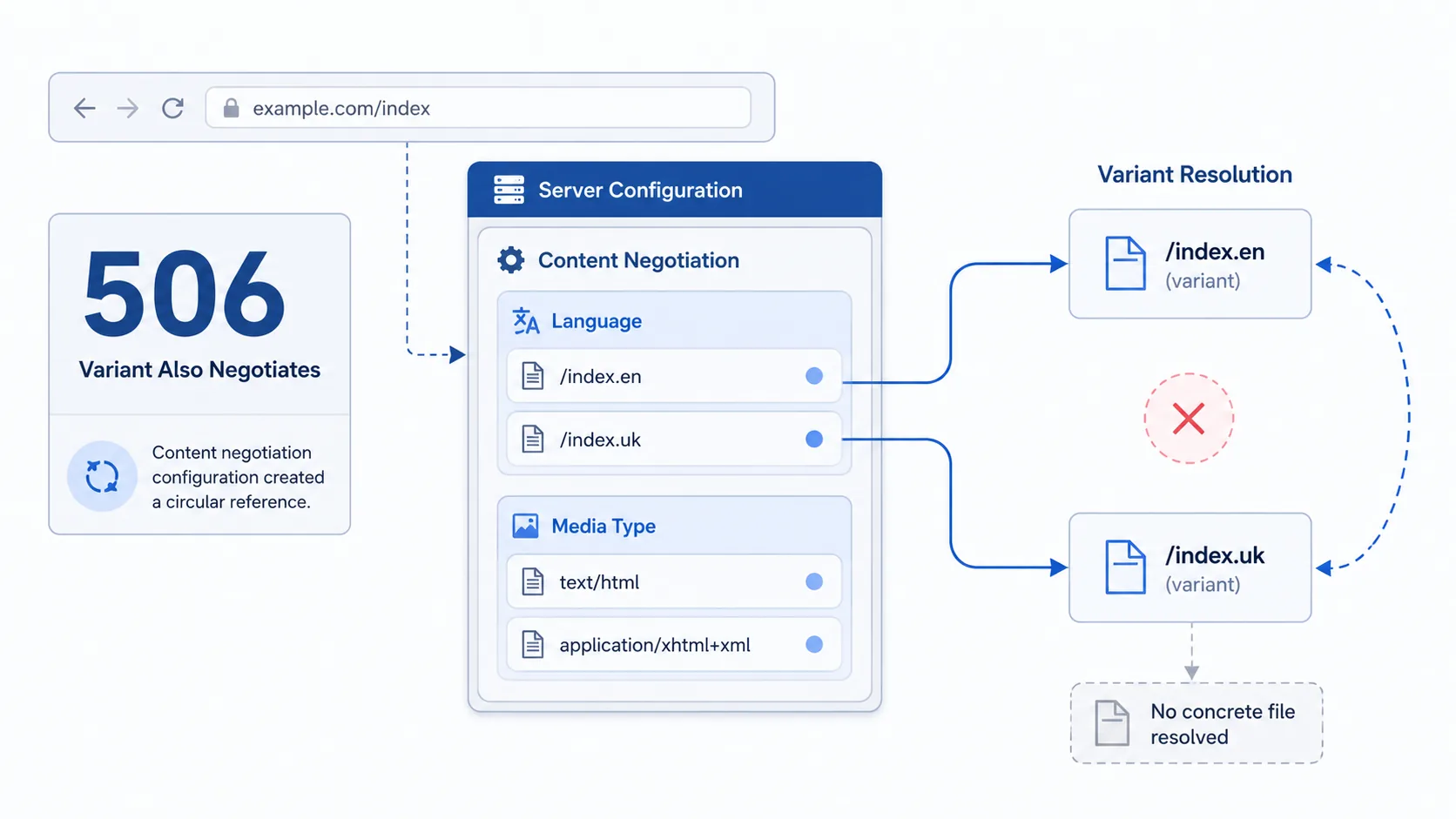
A quick reference view of how HTTP 506 indicates a server-side content negotiation loop instead of a standard redirect or concrete file.
What 506 Means
The shortest useful reading of this status code.
Variant Also Negotiates means the selected representation has a circular negotiation configuration.
For negotiation failures, the key distinction is that the server loop is inside representation selection rather than in generic routing or protocol parsing.
Quick read
Circular variant selection
A 506 means representation negotiation selected another negotiable variant instead of one concrete result.
Technical Context
How this status behaves without turning the page into a repair guide.
Negotiation loop
The useful reading of 506 is that the negotiation system chose a result that cannot actually terminate the selection process. Instead of ending with one concrete representation, the server lands on another negotiable variant and creates a circular path. The response therefore signals a configuration fault inside representation handling, not a malformed request from the client.
Status-code boundary
That makes 506 different from 300, 505, and 508. A 300 exposes multiple possible representations to the client. A 505 rejects the HTTP protocol version. A 508 signals a broader processing loop. A 506 is narrower: the loop is specifically inside the server's representation negotiation logic.
Related HTTP Codes
Nearby HTTP status codes help clarify how 506 differs inside the same response family.
506
Variant Also Negotiates
the selected representation has a circular negotiation configuration
300
Multiple Choices
the request has more than one possible response representation
505
HTTP Version Not Supported
HTTP Version Not Supported
508
Loop Detected
the server found an infinite processing loop while handling the request
Common Causes
Server negotiation config points a variant back to itself
The chosen representation loops back into the same negotiation system instead of ending at one concrete file or view.
Transparent content negotiation mapping creates circular representation selection
Negotiation logic keeps selecting another negotiable variant instead of one stable result.
Variant metadata references another negotiable resource instead of a concrete file
The variant map resolves to a target that re-enters negotiation rather than terminating the representation choice.
Typical Scenarios
A content negotiation setup for language or media variants accidentally points one variant at another negotiable resource
A server uses transparent negotiation rules and the chosen representation loops back into the same selection logic
Variant metadata for an alternate file references a negotiable target instead of a concrete stored representation
What To Know
A 506 usually points to misconfigured variant metadata or negotiation rules on the server side. The important distinction is that the server reached the representation-selection stage but could not resolve it to one stable concrete result.
Frequently Asked Questions
Common interpretation questions about HTTP 506.
Usually no. It generally indicates that the server's own negotiation setup for alternate representations is circular or internally inconsistent.
A 506 is specifically about circular representation negotiation. A 508 is a broader server-side loop detection status that is often discussed in recursive or WebDAV-style traversal contexts.