HTTP Status Codes
HTTP 501 Not Implemented
Not Implemented — the server does not support the HTTP method used in the request
501 indicates a permanent limitation of the server — the feature or method requested is not supported. It differs from 405 which means the method is recognized but not permitted for that specific resource.
Visual summary
A quick reference view of how HTTP 501 works: A server missing the internal module or tool required for the requested HTTP method.
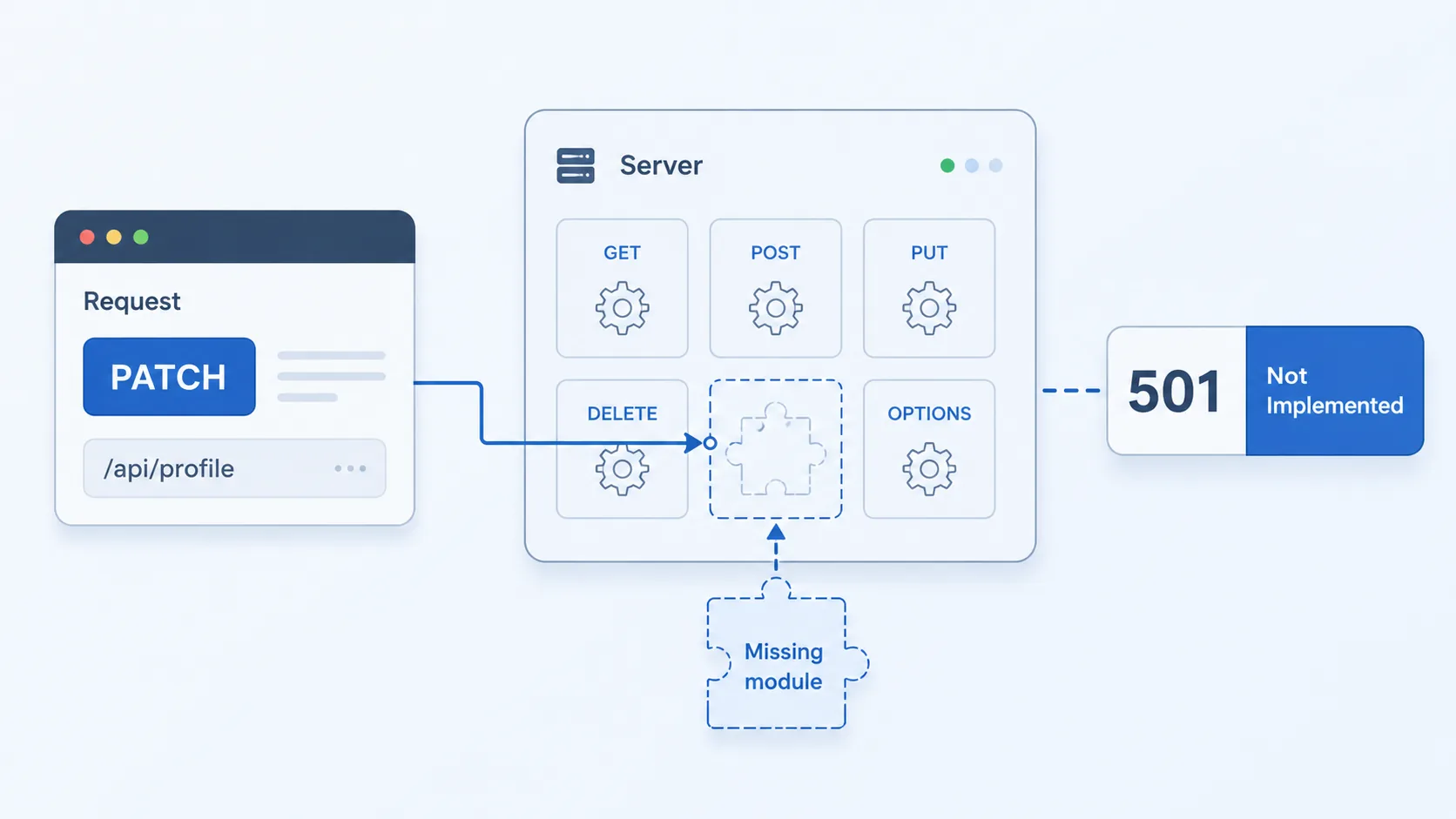
What 501 Means
The shortest useful reading of this status code.
Not Implemented means the server does not support the HTTP method used in the request.
This status falls into the 5xx class, indicating a server-side error outcome for the request.
Quick read
Not Implemented
the server does not support the HTTP method used in the request
How to fix 501
General informational guidance, not professional advice. Commands can affect your system or data — back up first and proceed at your own risk. FixerCode is an independent reference, not affiliated with any vendor mentioned.
Confirm the rejected method
Send the same HTTP method that produced 501 and confirm the server reports a capability gap for that method.
curl -i -X PATCH https://example.com/resourceCompare with a known supported method
Request the same resource with a method the server is expected to support. A different status helps separate a missing method implementation from a missing URL.
curl -i -X GET https://example.com/resourceUse 405 when the method exists but is blocked
If the server understands the method but the specific resource does not allow it, return 405 with an Allow header instead of 501.
Review protocol version separately
If the failure is tied to the HTTP version rather than the method, compare it with 505 because that status describes an unsupported protocol version.
Technical Context
How this status behaves without turning the page into a repair guide.
Standard usage
A 501 response means the server either does not recognize the request method or lacks the ability to fulfill it. This is distinct from 405 Method Not Allowed, which means the method is recognized but not permitted for that specific resource.
Technical nuance
Unlike 404 or 500, a 501 indicates a fundamental server capability gap. Clients should consult server documentation and switch to a supported method.
Related HTTP Codes
Nearby HTTP status codes help clarify how 501 differs inside the same response family.
501
Not Implemented
the server does not support the HTTP method used in the request
500
Internal Server Error
the server hit an unexpected condition while handling the request
505
HTTP Version Not Supported
HTTP Version Not Supported
405
Method Not Allowed
the resource exists but does not accept this HTTP method
Common Causes
Client sends an HTTP method such as PATCH or TRACE that the server does not implement
A common condition that triggers a 501 response when the web server evaluates the transaction.
Attempting to use a newer HTTP feature against a legacy server
A common condition that triggers a 501 response when the web server evaluates the transaction.
Incorrect HTTP method in a programmatic API call
A common condition that triggers a 501 response when the web server evaluates the transaction.
Typical Scenarios
API client sending PATCH requests to a server that only supports GET and POST
Webhooks using HTTP methods not implemented by the receiving endpoint
Legacy application server receiving modern HTTP method extensions
What To Know
A 501 is a permanent server-side capability limitation, not a transient error. Unlike 405, which restricts a method on a specific resource, 501 signals the server has no implementation for the method at all.
Frequently Asked Questions
Common interpretation questions about HTTP 501.
501 means the server does not implement the method at all. 405 means the server understands the method but that specific resource does not allow it.