HTTP Status Codes
HTTP 425 Too Early
Too Early — the server rejects the request before replay-sensitive processing begins
A 425 Too Early response means the server is unwilling to process the request because it arrived in a form that could be replayed before the connection state is fully confirmed. It is tied to early data and replay-risk protection rather than to ordinary request syntax.
Visual summary
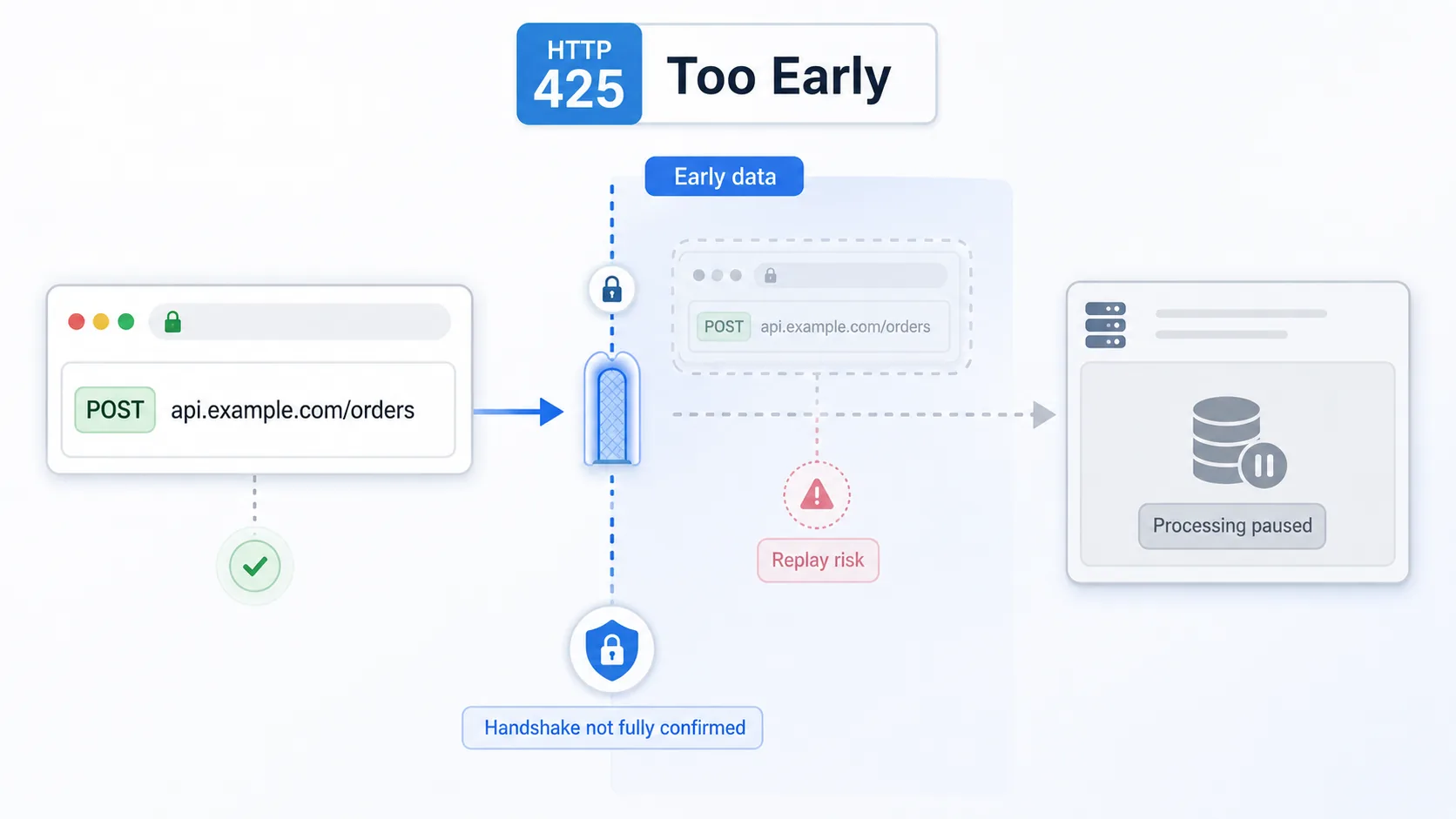
A quick reference view of how HTTP 425 delays replay-sensitive processing when a valid request arrives too early in the connection state.
What 425 Means
The shortest useful reading of this status code.
Too Early means the server rejects the request before replay-sensitive processing begins.
For early-data rejections, the useful distinction is timing: the server is declining replay-sensitive processing before the connection state is safe enough.
Quick read
Request arrived too early
A 425 means the server is avoiding replay-sensitive processing before the connection state is fully safe.
Technical Context
How this status behaves without turning the page into a repair guide.
Early data
A 425 exists to protect replay-sensitive operations. With early data features, a client can send application data before the connection handshake is fully settled. That improves latency, but it also creates scenarios where a request could be replayed by an attacker or intermediary under the wrong conditions.
Replay risk
Because of that, a 425 is not about malformed input or missing permissions. The server is saying the timing and transport context are too early for this specific request to be safely processed. In other words, the request may be valid, but not yet acceptable in its current replay-risk state.
Transport timing
This makes 425 a distinct modern transport-safety signal. It differs from 421 authority mismatches, from 426 upgrade requirements, and from 428 conditional-request policies by focusing on early-data replay risk rather than routing, protocol version, or resource preconditions.
Related HTTP Codes
Nearby HTTP status codes help clarify how 425 differs inside the same response family.
425
Too Early
the server rejects the request before replay-sensitive processing begins
421
Misdirected Request
the request reached a server that cannot answer for that authority
426
Upgrade Required
the server demands a different protocol before continuing
428
Precondition Required
origin server requires the request to be conditional
Common Causes
Server refuses TLS early data on a sensitive endpoint
The endpoint declines replay-prone early data before sensitive processing begins.
Replay-safe requirements block a non-idempotent request
The request could change state, so the server waits for a safer transport context.
Gateway policy disables early processing for state-changing actions
The edge accepts the connection but not this action in its current early-data phase.
Typical Scenarios
A client sends a non-idempotent request using TLS early data and the origin declines to process it yet
An edge gateway accepts connection setup but refuses early application data on a sensitive write endpoint
A replay-aware service blocks early processing for a transactional action that must not run twice
What To Know
A 425 usually points to replay safety and connection timing rather than to page-level application behavior. The useful distinction is that the server is being cautious about when the request is processed, not necessarily about what the request contains.
Frequently Asked Questions
Common interpretation questions about HTTP 425.
It means the server considers the current transport timing unsafe for this request, usually because early data could expose the action to replay risk.
Write operations can change state, create records, or trigger financial and transactional side effects. Those are exactly the kinds of actions a replay-aware server is more careful about processing too early.