HTTP Status Codes
HTTP 424 Failed Dependency
Failed Dependency — the request depends on another action that did not succeed
A 424 Failed Dependency response means the current action was not completed because it relied on another related action that already failed. It is most often seen in WebDAV and multi-step request sequences rather than in ordinary single-page browsing.
Visual summary
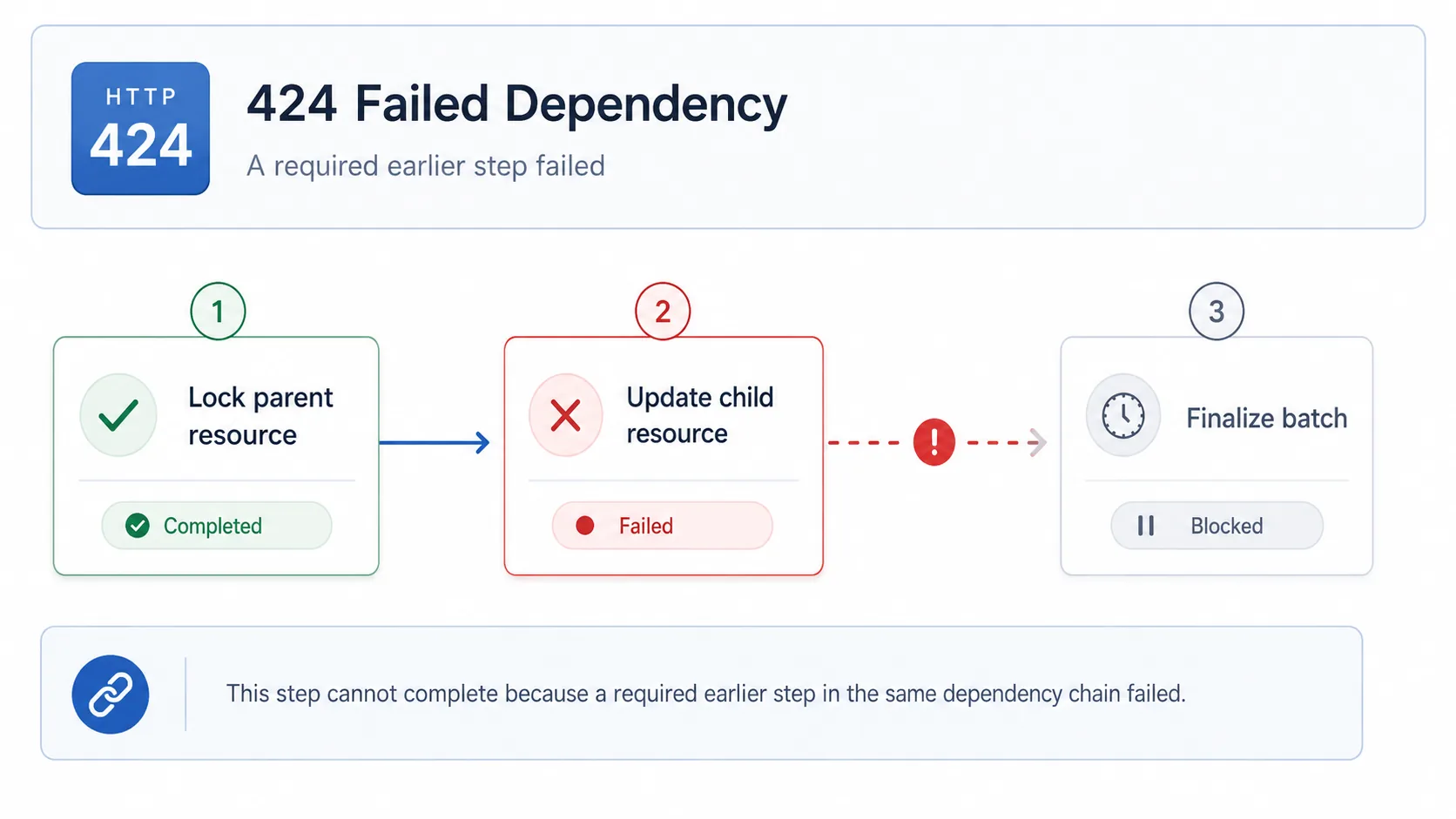
A quick reference view of how HTTP 424 blocks the current step because an earlier linked operation already failed.
What 424 Means
The shortest useful reading of this status code.
Failed Dependency means the request depends on another action that did not succeed.
For dependency failures, the useful distinction is that the current action failed because another required action already failed first.
Quick read
Blocked by a failed prerequisite
A 424 means the current action depends on another related action that already failed.
Technical Context
How this status behaves without turning the page into a repair guide.
Failed prerequisite
The main idea behind 424 is dependency chaining. The server is not saying the current request is malformed on its own; it is saying the request cannot succeed because another required action in the same broader operation already failed. This makes it a coordination status more than a standalone validation error.
Linked operation
That sets 424 apart from 423, 409, and 412. A 423 says the resource is locked, a 409 points to a conflict in current state, and a 412 says a stated precondition evaluated false. A 424 instead points to upstream failure inside a linked request sequence.
Sequence state
For readers, the most helpful interpretation is to treat 424 as a dependency-state problem. The current operation is blocked not because it is independently impossible, but because an earlier required step left the workflow in a failed chain.
Related HTTP Codes
Nearby HTTP status codes help clarify how 424 differs inside the same response family.
424
Failed Dependency
the request depends on another action that did not succeed
423
Locked
Locked
409
Conflict
the request clashes with the current state of the target resource
412
Precondition Failed
a conditional header did not match current resource state
Common Causes
Earlier dependent operation failed in the same sequence
The current step cannot complete because an earlier required action already failed.
WebDAV action relies on a locked or invalid parent resource
The target step depends on upstream resource state that is already blocked or invalid.
Batch request includes one prerequisite that did not complete
The wider sequence breaks because one required item never reached a usable state.
Typical Scenarios
A multi-resource WebDAV update stops because one earlier operation in the same sequence failed
A client tries to modify a resource whose required parent action was rejected first
A batch workflow aborts the current item because a prerequisite state change never completed
What To Know
A 424 is usually a sequence-level signal. It often appears where several related operations are expected to succeed together and one failed step makes the rest of the chain invalid or meaningless to continue.
Frequently Asked Questions
Common interpretation questions about HTTP 424.
A 423 means the target resource is locked. A 424 means the current action failed because it depended on another action that already failed.
Yes. It is most strongly associated with WebDAV-style multi-step operations and other request chains where one failure can invalidate the dependent actions that follow.