HTTP Status Codes
HTTP 421 Misdirected Request
Misdirected Request — the request reached a server that cannot answer for that authority
A 421 Misdirected Request response means the server received the request on a connection that does not match the authority it is willing or configured to serve. It is most associated with modern connection reuse, TLS, and virtual-host routing boundaries.
Visual summary
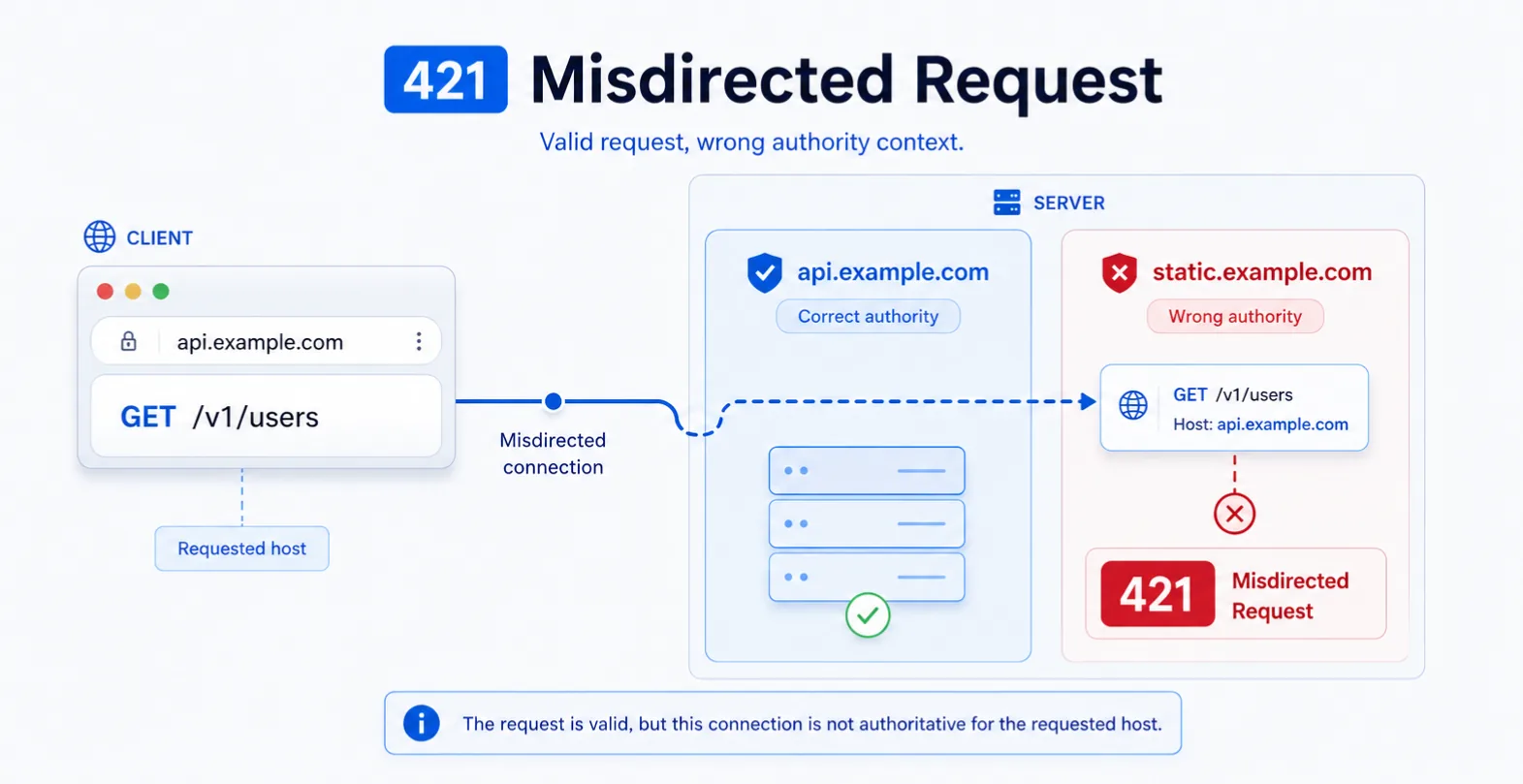
A quick reference view of how HTTP 421 rejects a valid request that arrived on a connection or server context not authoritative for that host.
What 421 Means
The shortest useful reading of this status code.
Misdirected Request means the request reached a server that cannot answer for that authority.
For misdirected requests, the key distinction is that the request may be valid but arrived on a connection or authority context the server will not answer for.
Quick read
Wrong authority context
A 421 means the request reached a server or connection context that is not valid for that authority.
Technical Context
How this status behaves without turning the page into a repair guide.
Authority mismatch
A 421 is not a generic malformed-request status. The request itself can be perfectly valid, but it arrived on a connection the server does not consider authoritative for that hostname or resource scope. In practice, this often relates to connection coalescing in HTTP/2 or to strict TLS and host-matching behavior.
Connection reuse
That makes 421 different from 400 and 503. A 400 points to request syntax or framing problems, while a 503 points to temporary unavailability. A 421 instead says the request reached the wrong serving context even though the server is otherwise running.
Origin boundary
This status helps infrastructure layers express a routing or authority-boundary problem without pretending the resource is missing or the server is broadly unavailable. It is especially useful where several hostnames, certificates, or origin mappings share one technical edge.
Related HTTP Codes
Nearby HTTP status codes help clarify how 421 differs inside the same response family.
421
Misdirected Request
the request reached a server that cannot answer for that authority
400
Bad Request
the server cannot process the request because it is malformed
425
Too Early
the server rejects the request before replay-sensitive processing begins
426
Upgrade Required
the server demands a different protocol before continuing
Common Causes
HTTP/2 connection reused for the wrong origin
The connection stays open, but the next request is not valid for that authority scope.
TLS or virtual host routing mismatch
The request lands on infrastructure that does not match the hostname or certificate context.
Reverse proxy forwards traffic to the wrong authority context
Edge routing sends the request into a serving context that is not responsible for that authority.
Typical Scenarios
A browser reuses an HTTP/2 connection for a hostname that the current certificate or server configuration does not cover
A reverse proxy terminates TLS correctly but forwards the request into the wrong virtual host context
Multiple origins share infrastructure and one request lands on a connection scoped to another authority
What To Know
A 421 usually points to connection authority, host mapping, or edge-routing boundaries rather than to page-level application logic. The important distinction is that the request arrived, but not in a context the server accepts for that authority.
Frequently Asked Questions
Common interpretation questions about HTTP 421.
No. A 421 can happen even when the request is structurally valid. The problem is that the request reached a server or connection context that does not match the authority being requested.
HTTP/2 encourages connection reuse across requests. A 421 gives the server a precise way to reject reuse when the current connection is not valid for the requested origin.