HTTP Status Codes
HTTP 303 See Other
See Other — the response is available at a different URL via GET
A 303 See Other response tells the client to retrieve a different resource using GET. It is often used after a state-changing request when the server wants the next step to point at a separate confirmation or result URL rather than repeat the original method.
Visual summary
A quick reference view of how HTTP 303 turns a submitted request into a follow-up GET at a separate result URL.
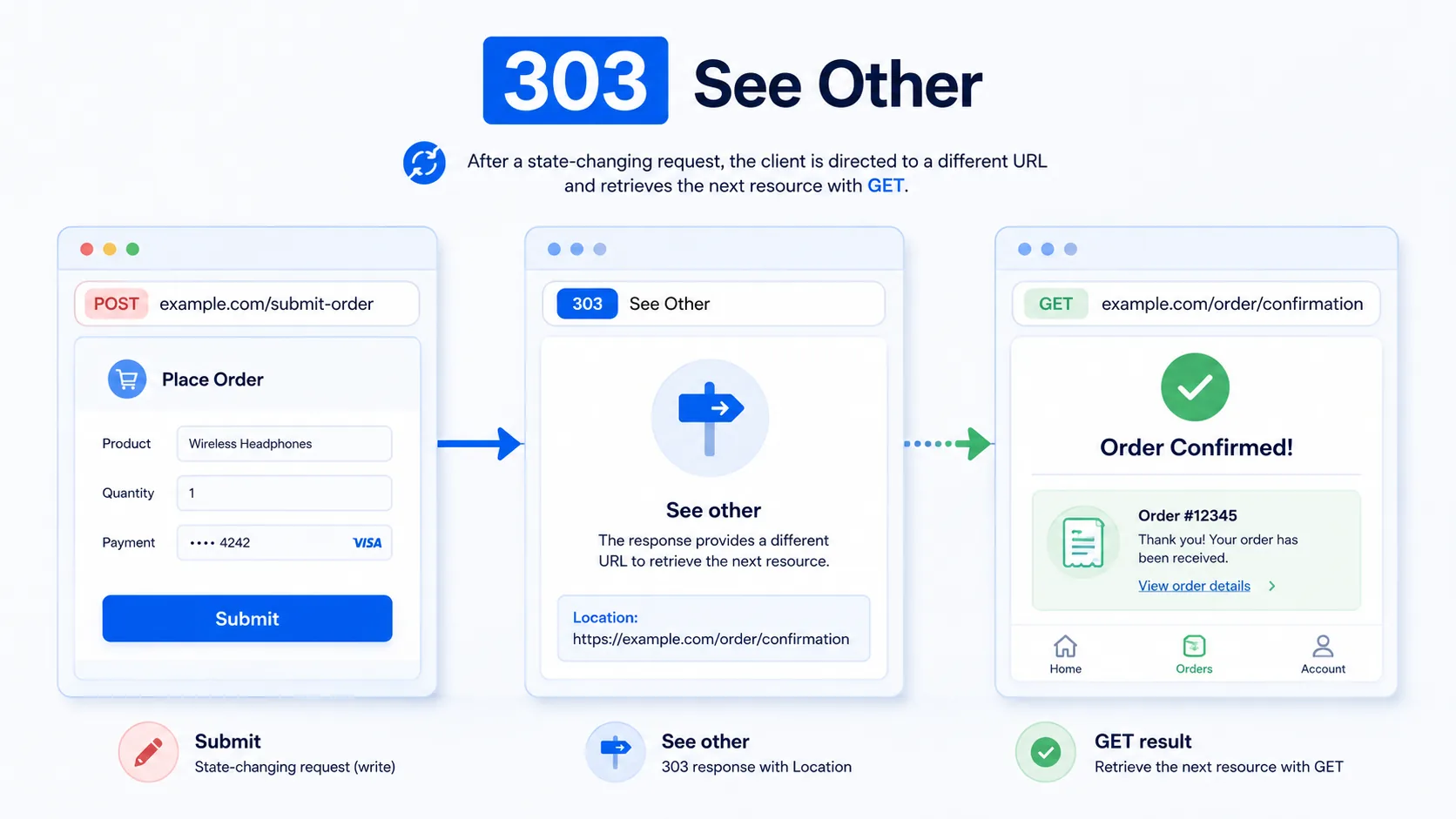
What 303 Means
The shortest useful reading of this status code.
See Other means the response is available at a different URL via GET.
For redirect workflows, the key distinction is that 303 sends the client to another URL with GET rather than preserving the original request method.
Quick read
Redirect to a GET result
A 303 moves the client to another URL where the next request is expected to be a GET.
Technical Context
How this status behaves without turning the page into a repair guide.
See Other target
The key behavior of 303 is method switching. Even if the original request was POST, PUT, or another method, the client is expected to fetch the new Location with GET. That makes 303 a clean fit for workflows where the follow-up resource is informational rather than a continuation of the original write operation.
GET follow-up
This separates 303 from 302 and 307. A 302 historically left room for inconsistent method handling across clients, while 307 explicitly preserves the original method. A 303 removes that ambiguity by telling the client to look elsewhere with GET.
Workflow handoff
Because of that distinction, 303 often appears in form-processing, asynchronous job handoff, or API flows where the server wants to prevent the user agent from replaying a non-GET request against the redirect target.
Compare Redirect Codes
Redirect status codes look similar in search results, so this page highlights the distinctions that make 303 different.
303
See Other
the response is available at a different URL via GET
302
Found
target resource resides temporarily under a different URI
307
Temporary Redirect
the resource temporarily resides at a different location
308
Permanent Redirect
the resource was permanently moved without method changes
Common Causes
POST request redirected to a confirmation resource
The write action is complete, and the server points the client to a separate result page.
Application follows a Post Redirect Get pattern
The workflow intentionally separates a state-changing request from the next read-only page.
Temporary alternate representation exposed at another URI
The server wants the client to retrieve a different view of the outcome at another address.
Typical Scenarios
A form submission ends by redirecting the browser to a success page with a normal GET request
An API accepts a request and points the client to a separate status or result resource
A workflow turns a write action into a follow-up read against a canonical view of the outcome
What To Know
A 303 is usually a workflow signal, not a failure state. It often means the server accepted or processed the earlier step and now wants the client to read the outcome at another address instead of repeating the original request semantics.
Frequently Asked Questions
Common interpretation questions about HTTP 303.
A 303 tells the client to fetch the next URL with GET. A 307 keeps the original HTTP method and request body when following the redirect.
It cleanly separates the write action from the page the user sees next. The browser moves to a read-only confirmation URL instead of replaying the original POST at the destination.