HTTP Status Codes
HTTP 511 Network Authentication Required
Network Authentication Required — the client needs to authenticate to gain network access
A 511 Network Authentication Required response is generated by an intermediary (like a gateway or proxy) rather than the origin server. it signals that the client must interact with the network's authentication portal before traffic will be forwarded to the internet.
Visual summary
A quick reference view of how HTTP 511 works: A captive portal blocking the path to the wider internet until login is provided.
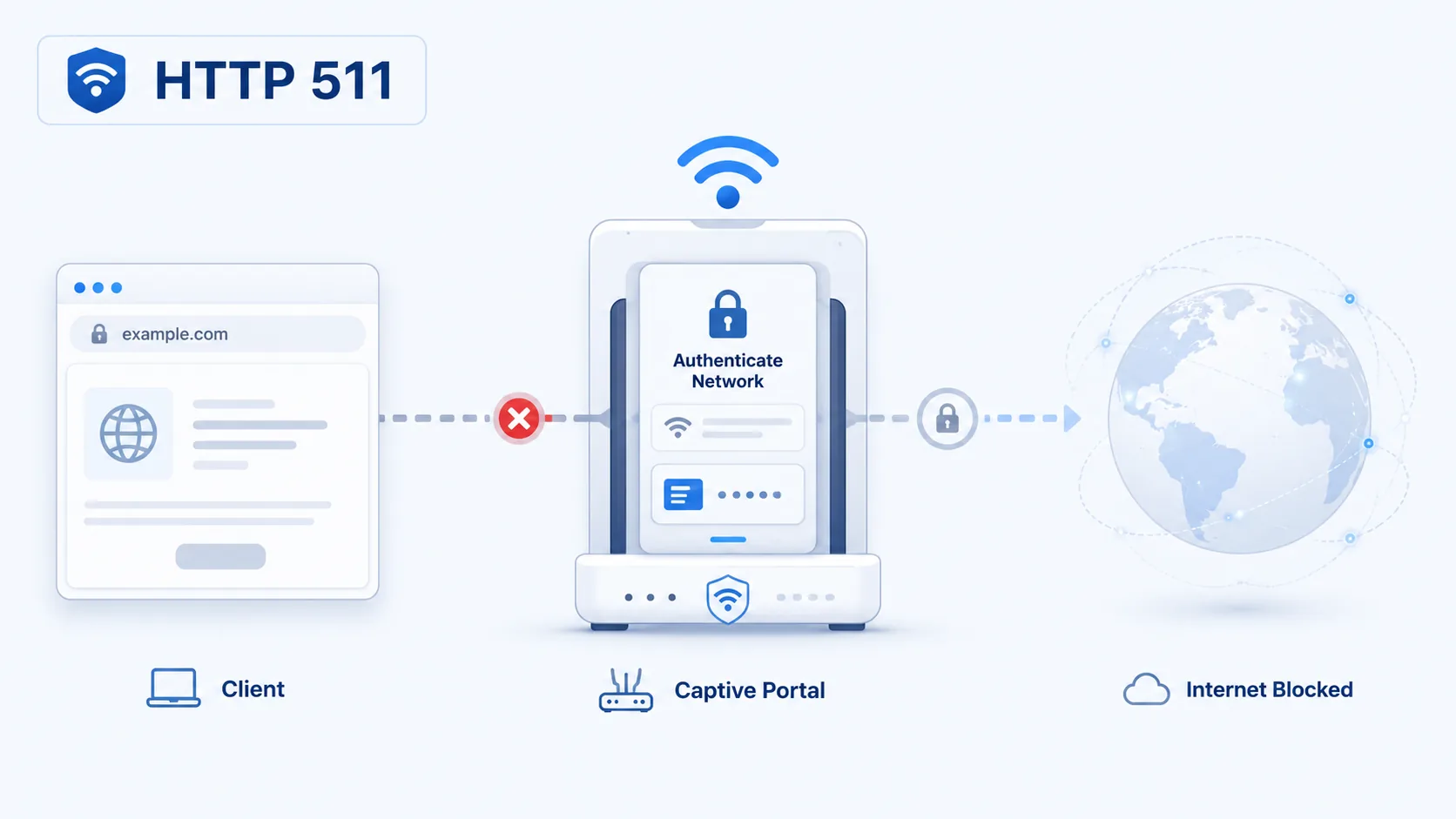
What 511 Means
The shortest useful reading of this status code.
Network Authentication Required means the client needs to authenticate to gain network access.
This status falls into the 5xx class, indicating a server-side error outcome for the request.
Quick read
Network Authentication Required
the client needs to authenticate to gain network access
Technical Context
How this status behaves without turning the page into a repair guide.
Standard usage
The 511 status is designed to handle 'captive portals' more gracefully. Before this code was standardized in RFC 6585, portals often returned 302 redirects or 200 OK with a login page, which confused automated clients and caused security issues.
Technical nuance
By using 511, the network explicitly tells the client: 'the problem isn't the website you're visiting, it's the network you're on.' This allows modern operating systems and browsers to automatically trigger the login UI.
Implementation detail
Security-wise, 511 prevents 'man-in-the-middle' confusion where a script might think it's talking to the real server when it's actually receiving a login page from a gateway.
Architecture
Introduced in RFC 6585, the 511 status code addresses a specific problem: before its standardization, captive portals often used 302 redirects or 200 responses with login HTML, causing automated HTTP clients to misinterpret the response as coming from the origin server. This led to content corruption in WebDAV applications, broken API integrations, and security concerns where credentials meant for the origin server were captured by the portal. The 511 code explicitly signals that the response is from a network intermediary, not the destination server.
Related HTTP Codes
Nearby HTTP status codes help clarify how 511 differs inside the same response family.
511
Network Authentication Required
the client needs to authenticate to gain network access
401
Unauthorized
valid authentication credentials are missing for the target resource
403
Forbidden
the server understood the request but refuses to authorize it
500
Internal Server Error
the server hit an unexpected condition while handling the request
Common Causes
Public Wi-Fi 'captive portal' requiring login or acceptance of terms
A common condition that triggers a 511 response when the web server evaluates the transaction.
Corporate network proxy demanding user identification before external access
A common condition that triggers a 511 response when the web server evaluates the transaction.
Intermediary network device intercepting traffic for authentication
A common condition that triggers a 511 response when the web server evaluates the transaction.
Typical Scenarios
A user connects to a hotel Wi-Fi and tries to fetch data, but the gateway redirects them to a login page
A background script fails because it is trapped behind a corporate firewall that requires a browser-based sign-in
A CI/CD pipeline running in a corporate environment fails to pull a Docker image because the network gateway requires SSO authentication before granting outbound internet access
What To Know
Opening a web browser to complete the network authentication process (e.g., logging into the Wi-Fi portal) grants the required internet access.
Frequently Asked Questions
Common interpretation questions about HTTP 511.
The network you are connected to (like public Wi-Fi) requires you to log in or accept terms before it will let you access the internet.
401 is sent by the origin server and carries a WWW-Authenticate challenge. 511 is sent by a network intermediary (not the origin server) and signals that the network itself requires authentication, not the specific website. Using 401 from a proxy would confuse clients into sending credentials to the wrong server.
No. RFC 6585 explicitly states that 511 should not be generated by origin servers. It is designed for intercepting proxies and network gateways. Origin servers should use 401 if authentication is needed for the specific resource.
Operating systems and HTTP libraries detect captive portals by sending probe requests to known detection URLs (like http://connectivitycheck.gstatic.com/generate_204). If the response is not the expected 204 No Content but instead a 511 or an HTML page, the client knows a captive portal is intercepting traffic and can trigger a login flow.